
Gaines County Release Date Sources
The first question is not “what calculator should be used?” It is “which agency owns the calculation?” Gaines County Jail holds local pretrial detainees and county-sentenced people. The court controls the judgment, sentence, bond, and later orders. TDCJ Classification and Records calculates the state-prison Projected Release Date. TxBPP controls parole and discretionary mandatory-supervision decisions.
| Custody setting | Best date source |
|---|---|
| Pretrial at Gaines County Jail | Court order, bond event, and GCSO status; often no fixed release date |
| County jail sentence | Signed judgment, jail credit, and GCSO jail-time computation |
| TDCJ sentence | TDCJ Online Inmate Search and Classification and Records |
| Parole review | TxBPP decision plus TDCJ Review and Release Processing |
| Federal sentence | BOP locator and federal records |
A county-jail departure and a state-prison release are separate events. If GCSO transferred a person to TDCJ after felony commitment, the county exit date is not a community release date. Follow the state record for the next projected or actual event.
Find a Gaines Projected Date
Gather the full name, booking or case number, approximate arrest date, and last known custodian. For TDCJ, a SID or seven-digit TDCJ number provides the cleanest match. A surname and first initial can also be used, but compare age, county of conviction, offense, and sentence before accepting a result.
- Ask GCSO whether the person is pretrial, county-sentenced, or transferred.
- Read the signed judgment and docket for sentence length, start, jail credit, and later orders.
- For state custody, open the TDCJ Online Inmate Search and verify identity.
- Record Projected Release Date, maximum sentence date, parole eligibility or review date, location, and parole decision together.
- After a favorable vote, ask TDCJ Review and Release Processing about actual status.
- Check for a detainer, new case, corrected credit, disciplinary change, or other hold.
- Recheck near the displayed date and confirm the actual exit with the releasing agency.
If the online state search is incomplete, TDCJ's email information route asks for full name and TDCJ number. Without that number, it requests exact date of birth, or approximate age and county of conviction. The listed no-charge response fields include incarceration history, current offense and court, and Projected Release Date. That email service does not provide photographs.
Gaines Scheduled Versus Actual Release
TDCJ defines Projected Release Date as the date calculated by its Classification and Records Office on which an inmate is projected to leave incarceration if not paroled sooner. It is not a gate appointment. The displayed date can relate to mandatory supervision or discharge depending on offense date, eligibility, and Board action.
A favorable parole vote also is not an immediate release. Release planning, imposed conditions, program prerequisites, detainers, and administrative review may remain. TDCJ Parole Division Review and Release Processing handles work between approval and actual release and can address status at (512) 406-5202.
What Changes Gaines Release Dates
A release calculation can move in either direction as the legal and custody record changes. The cause must be identified rather than guessed from a new display value.
| Change | Possible effect |
|---|---|
| Jail credit correction | Changes time credited before sentence computation. |
| Good-time accrual or forfeiture | Can affect parole or mandatory-supervision eligibility under state rules. |
| New or stacked sentence | Changes concurrent or consecutive time structure. |
| Detainer or hold | Can prevent community release or route the person elsewhere. |
| Parole decision | May permit earlier conditional release or set later review. |
| Program or condition | May require completion before an approved release is processed. |
| Court order | Can alter custody authority, credit, or sentence terms. |
Maximum sentence date, parole review information, current location, and projected date should always be read as a set. One field alone cannot show whether release is mandatory, discretionary, conditional, blocked, or already complete.
Texas Good Time in Gaines
Texas Government Code Chapter 498 controls good-conduct time for TDCJ. Section 498.003 treats good time as a privilege used for parole or mandatory-supervision eligibility; it does not otherwise reduce the sentence term. Accrual depends on classification and qualifying activity or capability. The chapter provides different rates, including up to 20 days per 30 days actually served in specified classes, possible additional trusty credit, 10 days per 30 in Class II, and none in Class III or where excluded. Credits may be forfeited for disciplinary violations.
That framework cannot be turned into “sentence minus credits equals guaranteed release.” Good time may advance eligibility while parole remains denied or mandatory supervision is excluded or discretionary. The calendar maximum still matters. Current classification, discipline, offense rules, and Board action must be checked in the official state record.
No Universal Gaines 85% Rule
Texas does not impose one universal rule that every person serves 85 percent of a sentence. Government Code Chapter 508 uses offense-specific parole and mandatory-supervision rules. Certain serious offenses can require actual calendar time equal to one-half of the sentence or 30 calendar years, whichever is less, subject to statutory details and minimums. Other cases combine actual time and good conduct. Section 508.149 excludes listed categories from mandatory supervision.
A lawful calculation needs the offense date, statute of conviction, deadly-weapon finding, sentence, prior or stacked sentences, jail credit, and current eligibility status. Multiplying a sentence by .85 ignores those facts. The TDCJ result and a Classification and Records response are safer than an unofficial calculator.
Gaines Sentence Structure Matters
State-jail felonies and other sentence types can follow different release structures. Concurrent terms run together, while consecutive terms run in sequence. Jail credit, offense-specific exclusions, prior sentences, and a deadly-weapon finding can change eligibility. Each fact must come from the signed judgment or current corrections record.
A case docket may show that a sentence was corrected or that another cause added a hold. TDCJ may then update its calculation. Preserve the earlier display, note when the new value appeared, and ask for the record supporting the change. A changed date is not proof of an error by itself.
Gaines County Jail Date Calculation
A local county sentence uses a different record chain. Start with the signed judgment, sentence start, credit for presentence confinement, and any lawful county-jail credit. No published Gaines County good-time schedule or weekend-release policy was found. GCSO should supply the jail-time computation or release authorization, while the proper clerk supplies the judgment and later orders.
Pretrial custody is different again. A detainee may leave after bond, dismissal, a court order, or transfer, and no fixed future date may exist. A new hold, another case, corrected credit, or court action can change an expected county exit. Do not apply TDCJ's Projected Release Date definition to a person who never entered state custody.
- Projected release date
- TDCJ's calculated date for leaving incarceration if parole does not occur sooner.
- Parole
- Conditional release while the sentence continues under supervision.
- Mandatory supervision
- A statutory conditional-release process whose availability and approval depend on the case.
- Discharge
- Completion of the sentence obligation.
- Detainer
- A hold from another authority that can redirect or delay release.
Read Gaines State Date Fields
TDCJ may place several dates near each other. Projected release is a calculated exit if parole does not occur sooner. Maximum sentence date marks the sentence endpoint in the record. Parole eligibility or review dates describe when Board consideration may occur, not a promised exit. Approval is another step, but processing can remain.
Write each label exactly as displayed. Note location, offense, conviction county, sentence date, and sentence length. These facts help reject a wrong match and explain which rules may apply. If public history is incomplete after discharge, use the TDCJ email or Public Information Act route instead of recreating the date.
The official TDCJ definitions page supplies the precise projected-date meaning.
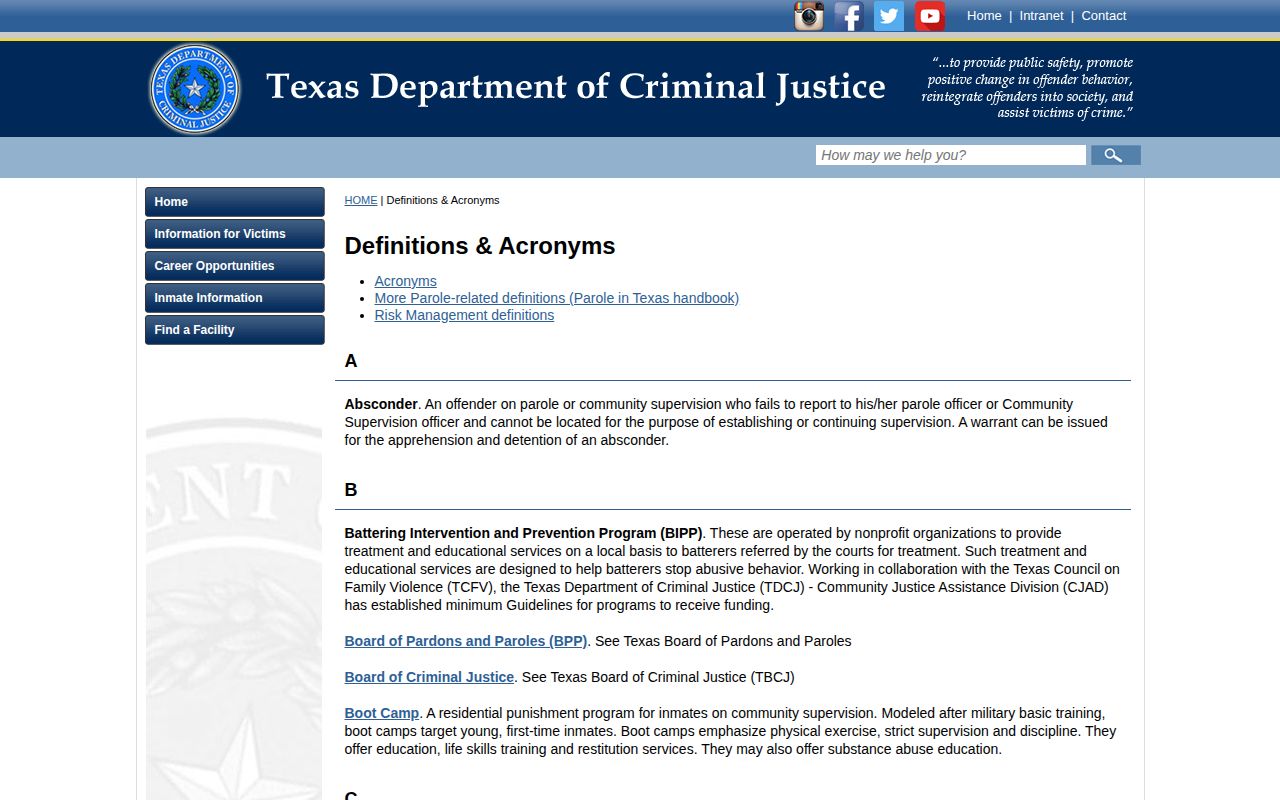
The definition ties the estimate to state Classification and Records work, not to a Gaines County pretrial booking.
For offenses before September 1, 1996 that are legally eligible for mandatory supervision, TDCJ explains that the projected date can serve as the mandatory-supervision date if parole has not occurred. For eligible offenses on or after that date, TxBPP discretion applies. When the Board does not approve release, or the person is ineligible, the date takes on a discharge or maximum-term role. Offense date is therefore part of the calculation, not a minor detail.
Parole review adds another timeline. TDCJ identifies a person for initial review roughly six months before eligibility and for later review roughly four months before the next review date. A three-member panel reviews the file, and two matching votes decide it. Texas does not use a formal public hearing calendar for ordinary parole consideration. The result date and release date should never be treated as the same event.
Verify the Gaines Release Event
Record the date on which each interface was checked and quote the precise field label. Compare the maximum sentence and parole-review dates. Check the current TxBPP result. Ask about detainers and prerequisites after a favorable vote. Then confirm the actual release with the agency that processed it.
For a county sentence, request the GCSO jail-time computation and release authorization as existing records. Compare those records with the clerk's signed judgment and jail-credit entries. If the dates differ, ask which later order, detainer, new case, or corrected credit controls. An unofficial calculator cannot settle a conflict within the official record.
The Gaines County VINE Inmate Check can provide status or notification for the correct county or state system, but its alert is not a sentence calculation. For the broader sheriff, court, TDCJ, and federal record path, use the Gaines County released-inmate lookup. Dates become reliable only when the custodian, sentence, and event type all match.
For a local cross-check, use the Gaines County Sheriff for the jail exit or transfer, the Gaines County Clerk for county-level cases, and the Gaines County District Clerk for district felony records.